Connection amid loneliness
The Woman in the WindowConnection amid loneliness is a fragile pattern in Anna’s life: she reaches toward other people even as fear, confinement, and bereavement keep her apart from them. The connection can be as direct as giving an online stranger her name, as limited as watching neighbors through a camera, or as painful as continuing to hear the voices of the dead. Across these forms, the story distinguishes contact from cure: a moment of human closeness matters, but it cannot by itself undo isolation or grief.
Anonymity and the risk of being known
Anna’s exchange with GrannyLizzie begins on the Agora, where Anna uses the handle thedoctorisin and has never shared her name, not even with Sally. She fears that someone might connect her name to her profession and thereby identify her. That guardedness makes her decision to type “I’m Anna.” more than a routine introduction. GrannyLizzie’s story has moved her: Anna recognizes an elderly widow who is alone and bereaved, and who puts on a brave face beneath enormous skies. She also recognizes the frightening fact that GrannyLizzie is housebound. The disclosure is small, but it crosses a boundary Anna has deliberately kept in place.
GrannyLizzie’s reply, “Thank you, Anna.”, gives the exchange a personal ending: she signs off knowing the name of the person who has listened. Anna feels her veins rushing and understands that she has helped someone and connected with her. The phrase “Only connect” comes to her then, making connection feel like a principle she has encountered before as well as a need fulfilled in the moment. Yet the immediate return to “I deserve a drink.” places that relief beside Anna’s reliance on alcohol. The contact is real, but it does not resolve the conditions that make her lonely.
Watching, visits, and limited companionship
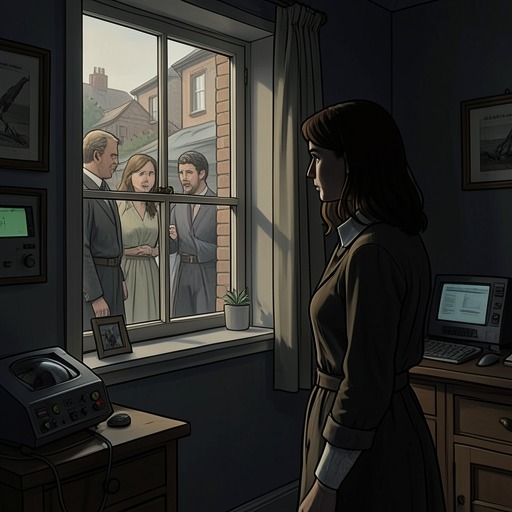
Anna’s attention to the neighborhood offers another, more distant form of contact. In her study, with a tumbler in one hand and the Nikon D5500 in the other, she surveys the street from the corner between the south and west windows. She zooms in on Rita Miller returning from yoga, smiling into a phone, and wonders who is on the other end. She watches Mrs. Wasserman and Henry descend the steps, then turns the camera toward two pedestrians outside a nearby house. This inventory gives Anna a view of other people’s ordinary movement, but the camera also holds them at a distance: she can inspect gestures and imagine conversations without taking part in them.
A visit brings a different kind of proximity. A woman arrives, embraces Anna, and jokes that she must be bored and tired of black-and-white movies. Anna laughs nervously, and the visitor moves past her before Anna has said anything. She has brought a cold bottle of Riesling. The hug and gift make the encounter tangible and welcome, while the wine gives it an uneasy edge in light of Anna’s repeated drinking. The scene therefore places companionship and vulnerability together rather than treating company as an uncomplicated remedy.
The online relationship with GrannyLizzie continues beyond their first exchange. When GrannyLizzie greets her as “Hello, Doctor Anna!”, Anna sets aside her glass and suspends a chess game. Later, GrannyLizzie reports that an old student has helped her take a short walk outside. Anna calls it a terrific step and encourages her; GrannyLizzie then says she must make lunch because a friend is coming over. The exchange records small changes in GrannyLizzie’s circumstances—an outing and a visitor—without claiming that Anna caused them. Anna can recognize and affirm those steps from a distance, just as GrannyLizzie can address her by name. The messages make a modest reciprocal space for attention, even though their contact remains online.
Care amid distress
Connection also appears in Anna’s treatment, where care is expressed through professional concern and medication adjustment. After an earlier session, a clinician tells her, “I felt concerned after our last session.” Anna pauses and cannot find an answer. The concern does not make speaking easy, but it establishes that her distress has been noticed. The clinician hopes that an adjustment in her medication will help, and Anna says she will keep him posted. This is contact shaped by a therapeutic relationship, distinct from friendship, but it too depends on an attempt to remain in communication when Anna is struggling to respond.
During the crisis involving the stabbed woman Anna believes is Jane, her contact with the nurse is urgent and impaired by alcohol. Asked whether she had been drinking, Anna admits she had, then insists that the nurse must help because the woman could be dead. The nurse moves to get the doctor. Here, connection is not reflective or reassuring: it is a plea for another person to act. Anna’s need to reach someone persists even while her slurred speech and drinking complicate how her report may be received.
The dead as an inward audience
The most painful version of connection follows the revelation that Anna’s husband and daughter are dead. Anna acknowledges the deaths rather than denying them, but Dr. Fielding identifies the state she has inhabited as denial. She explains that she hears the voices of people she has lost and of others associated with her life; they return when she is overwhelmed by absence, when she needs someone to talk to, and when she least expects them. They say “Guess who,” and she responds. The voices preserve an experience of being addressed, but they also show how intensely Anna’s need for company is bound up with loss.
That inward relationship continues in domestic moments. On her birthday, she hears Ed and Olivia chorus “Happy birthday,” then rolls away. She remembers that Jane’s birthday is the same date, a birthday she had given Jane. The brief sequence joins a remembered family ritual to the constructed birthday of another person, without making either a straightforward present-day encounter. Later, when Anna looks across the park toward the darkened Russell house and Ethan’s room, she hears the question, “What are you going to do, Mommy?” and tries to shut it out by focusing on Jane. The address offers the intimacy of a family voice at the same moment that Anna resists it.
The limits of connection
Anna’s relationships with GrannyLizzie, her visitor, her clinician, and the people whose voices she hears are not interchangeable. The first involves a chosen disclosure and an online exchange; the second offers physical presence; the clinical encounter registers concern; the voices express continuing attachment within grief. Alongside them, Anna’s camera supplies observation without reciprocity. Together, these forms show that isolation is not an absence of attention or longing: Anna watches, listens, answers, and sometimes reaches out. But the connections differ in what they can provide. The conversation with GrannyLizzie brings the unmistakable relief of helping and being thanked, while the voices of the dead keep intimacy available at the cost of making absence present again. The motif’s significance lies in that tension: connection sustains Anna, yet it does not erase the loneliness from which she seeks it.